Detection Methods of Self-Lensing Flares in Supermassive Black Hole Binaries
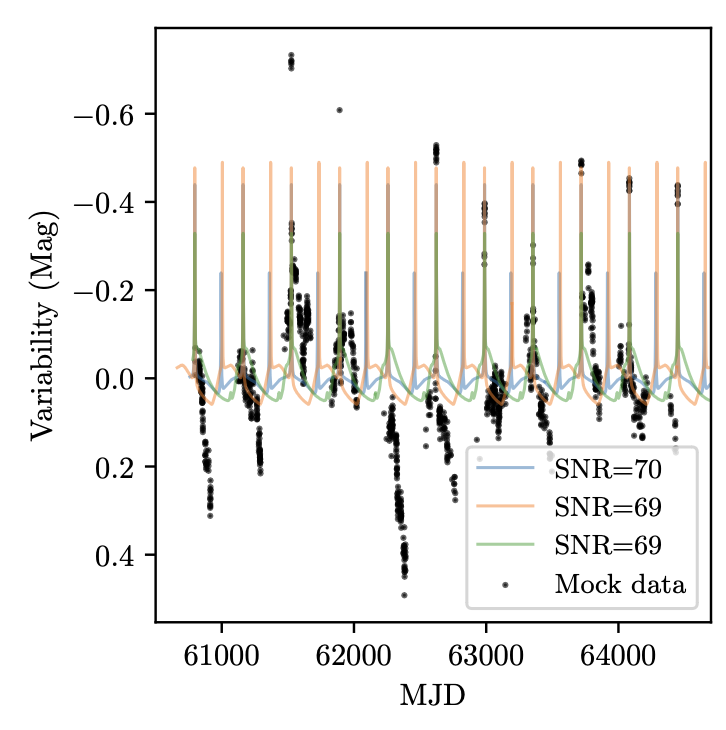
We generated mock supermassive black hole binary light curves at realistic observation times involving periodic accretion variability, relativistic Doppler boost, self-lensing flares, and quasar noise. We develop a three-step matched filter procedure to recover the periodicity of the self-lensing flares and injected binary parameters from noise and sparse sampling. We also show that standard Lomb-Scargle periodograms are ineffective in recovering injected periodicity due to the non-sinusoidal nature of the flares. The paper can be found at PRD.
Detection Rates of Black Hole Shadows and Self-Lensing Flares in Supermassive Black Hole Binaries in LSST
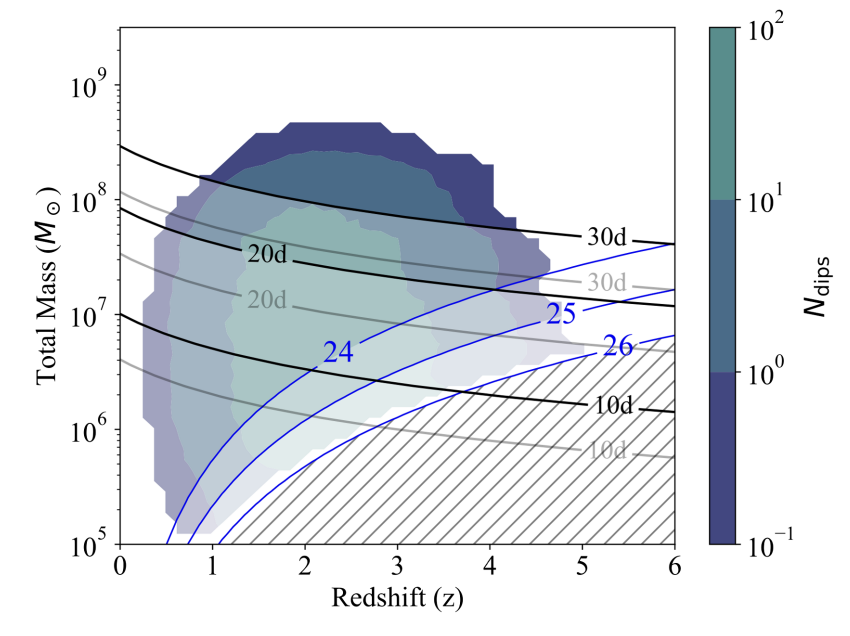
Following up on a series of three papers which simulate self-lensing flares and dips (caused by the black hole shadow) in supermassive black hole binaries with general relativistic ray-tracing methods, I calculated the detection rates of flares and dips in LSST. The paper was published in Physical Review D