Discovery of new Little Red Dots in DESI DR1
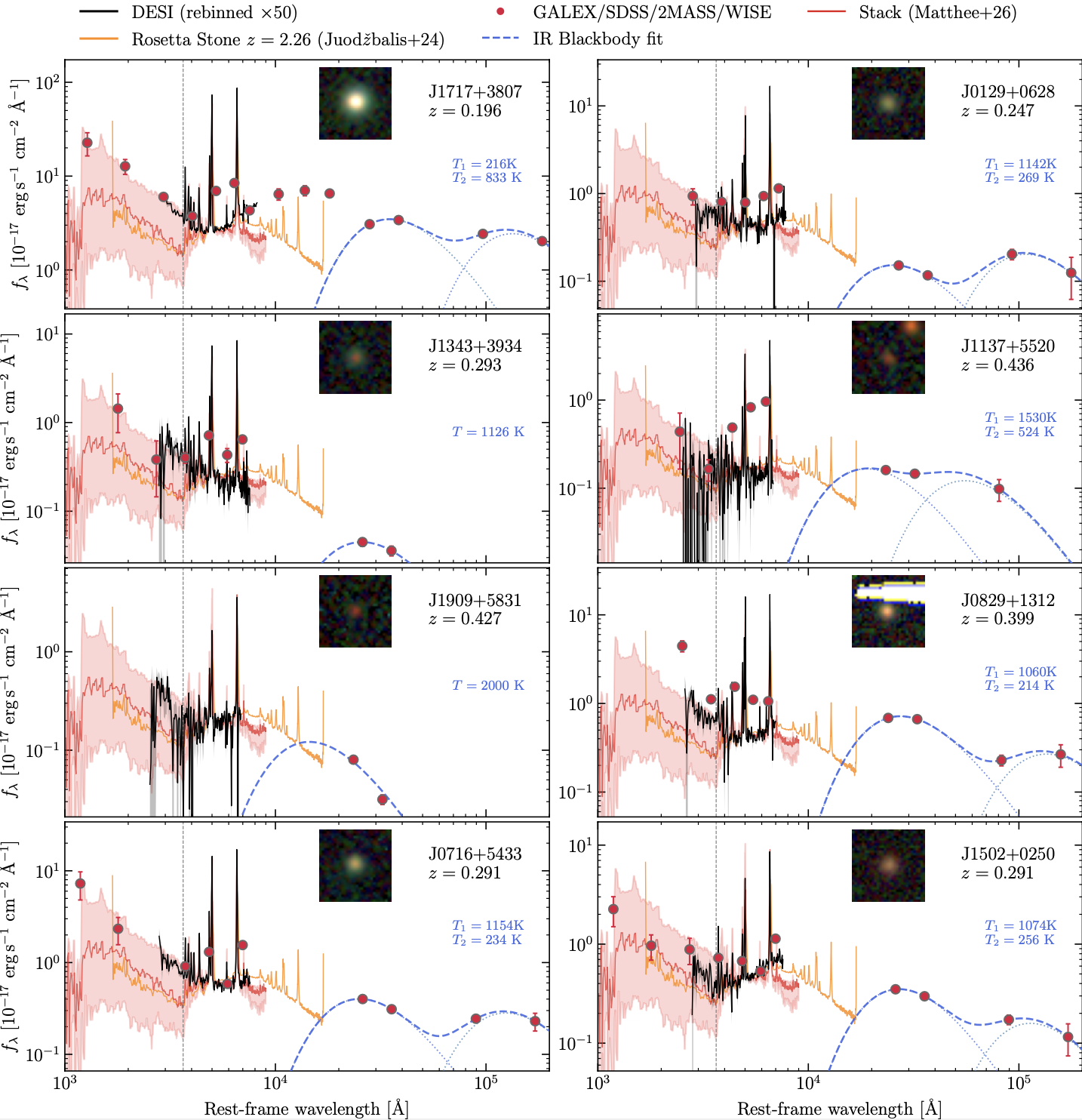
JWST has unveiled an abundant population of compact broad-line emitters at high redshift, the Little Red Dots (LRDs), which might represent a previously unprobed supermassive black hole evolution channel predominant at high redshift. We searched for low-redshift LRDs in the Dark Energy Spectroscopic Instrument (DESI) survey finding eight LRDs at z=0.2-0.45, which show spectral features similar to the high-redshift LRDs in the rest-frame optical. The sources are characterized by broad Balmer lines, steep Balmer decrements, compact morphologies, Balmer absorption features. Given the effective volume 4.9 Gpc^3 covered by DESI DR1 at z<0.45, our sample corresponds to a number density of 1.6x10^-9 Mpc^-3, indicating a number density ~10,000 times lower than in the first billion years of cosmic time. We find a dearth of luminous and red LRDs at z<1 compared to higher-redshift, which could suggest lower gas feeding rates of LRD activity due to higher metallicities at later cosmic epochs.
Detection Methods of Self-Lensing Flares in Supermassive Black Hole Binaries
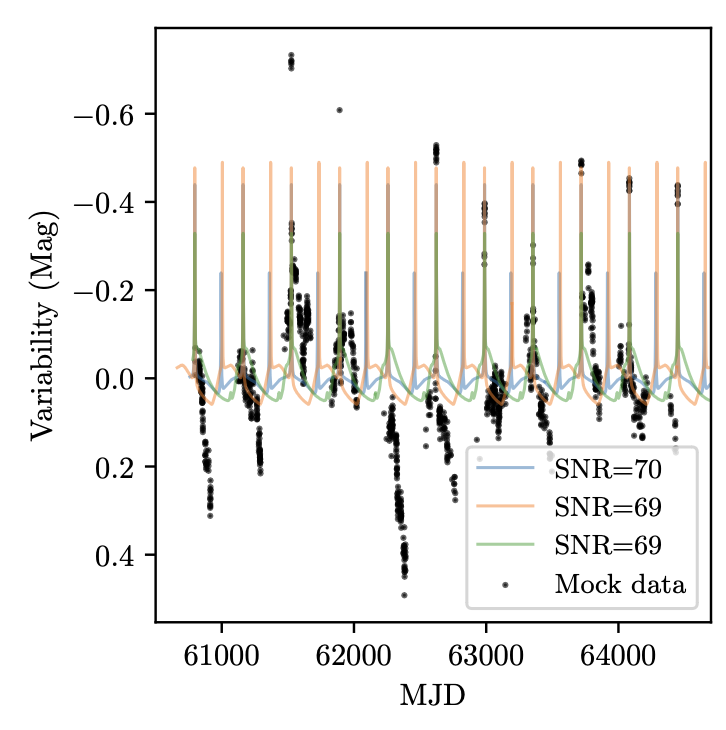
We generated mock supermassive black hole binary light curves at realistic observation times involving periodic accretion variability, relativistic Doppler boost, self-lensing flares, and quasar noise. We develop a three-step matched filter procedure to recover the periodicity of the self-lensing flares and injected binary parameters from noise and sparse sampling. We also show that standard Lomb-Scargle periodograms are ineffective in recovering injected periodicity due to the non-sinusoidal nature of the flares. The paper can be found at Physical Review D.
Detection Rates of Black Hole Shadows and Self-Lensing Flares in Supermassive Black Hole Binaries in LSST
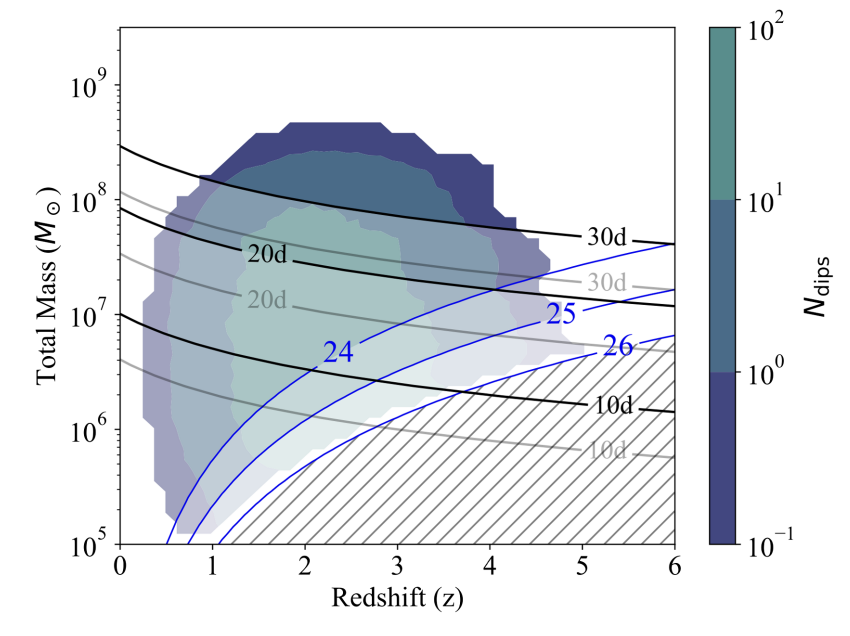
Following up on a series of three papers which simulate self-lensing flares and dips (caused by the black hole shadow) in supermassive black hole binaries with general relativistic ray-tracing methods, I calculated the detection rates of flares and dips in LSST. The paper was published in Physical Review D